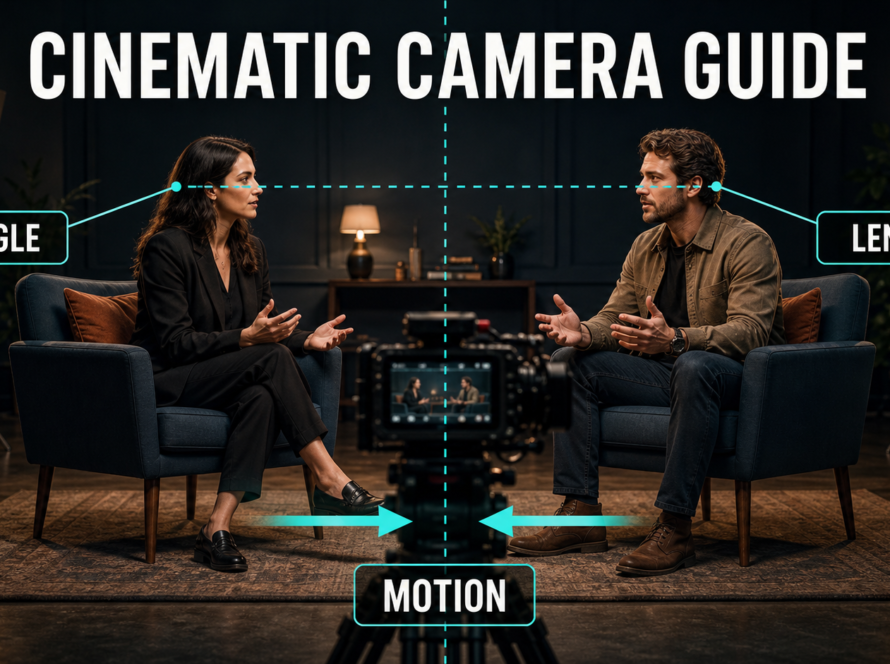
A 35mm full-frame-equivalent look works when a person and their surroundings matter together. In AI video, do not prompt only “cinematic 35mm.” Choose the audience’s narrative distance, place the virtual camera, protect the scene relationships, and then describe one action and one camera move.
This guide uses a three-beat reunion in a lantern-lit night market. The goal is not to prove that a generator simulated a physical lens. It is to select a believable 35mm visual target, turn it into observable constraints, and reject takes that lose context, connection, or continuity.
Table of Contents

Start with the story-distance test
Ask one question before choosing a focal-length word: what must viewers read in this beat? If the answer is the whole location, go wider. If it is a private facial reaction, go tighter. Choose 35mm when viewers must understand the face, body language, movement path, and enough environment to explain why the moment matters.
The three-beat reunion
Two old friends notice each other across a night market. Beat one establishes the lantern aisle and their separation. Beat two holds both people as recognition turns into a smile. Beat three follows two steps toward an embrace. One 35mm visual family can cover all three by changing distance and framing without turning the sequence into three unrelated optical styles.
This differs from Aikolhub’s 24mm reference reconstruction, which measures one approved frame, and the 14mm ultra-wide guide, which deliberately emphasizes depth. Here, the controlled variable is story distance across consecutive beats.
Why 35mm tells stories differently
35mm sits at the wide edge of many full-frame classifications, yet it can feel restrained when subjects stay away from the edges and the camera is not pushed into a face. It offers more surroundings than 50mm at similar subject size, making it useful for environmental portraits, moving two-shots, and compact interiors.
Angle of view and format
Nikon’s official focal-length guide places approximately 14–35mm in the FX wide-angle range and explains that shorter focal lengths widen angle of view while reducing magnification. Nikon’s official 35mm f/1.8G announcement lists a 63-degree FX angle of view. Always write “35mm full-frame-equivalent” when a virtual camera has no declared sensor, because 35mm on a smaller format produces a tighter equivalent view.
Perspective follows camera position
Focal length changes field of view; camera position determines perspective. Moving close to fill the frame makes near facial features, hands, or props loom. Backing up changes their size relationships. Therefore, “natural 35mm face” is not an adequate instruction. State the framing, distance class, edge safety, horizon, and visible background anchors.

Choose the shot with a decision tree
This decision tree prevents lens choice from becoming decoration. Follow the first branch that matches the information viewers need.
The decision path
- Must viewers first understand the whole market and both approach paths? Use a 24mm establishing view, or use the dedicated establishing and master-shot workflow.
- Must viewers read both faces, bodies, and the market relationship? Choose a 35mm two-shot with both actors inside the central two-thirds.
- Must viewers travel with the pair? Keep 35mm, step the camera back, and use one slow parallel or forward move.
- Must one private reaction dominate while context can soften? Move to a 50mm or tighter view rather than forcing a close 35mm portrait.
- Are the results still ambiguous? Generate one static frame for each option before animating; select by story information, not by surface polish.
Lens and settings comparison matrix
| Target | Story job | Placement | Depth target | Safe move | Stop condition |
|---|---|---|---|---|---|
| 24mm | Location and separation | Close enough to read bodies; protect edges | f/5.6–f/8 look | Short lateral reveal | Faces stretch or stalls bend |
| 35mm | Context plus connection | Conversational distance; chest-height camera | f/4–f/5.6 look | Slow push or parallel track | Background vanishes or hands loom |
| 50mm | Reaction and emotional isolation | Back up for a medium single | f/2.8–f/4 look | Locked or minimal push | Partner and market become unreadable |
Treat these as visual starting targets, not physical guarantees. The comparison itself is the original-value test: hold the scene, identities, action, duration, aspect ratio, and lighting constant, then change lens target and camera placement together.

Block the three-beat scene
Make an overhead sketch before prompting. Place the lantern stall frame right, a blue canopy frame left, Friend A near the foreground-left third, and Friend B deeper on the center-right. Keep a clear aisle between them. Put the camera just outside the walking path at chest height, facing diagonally through the market rather than flat against a stall.
Beat one: context
Begin with a medium-wide 35mm two-shot. Both people should be identifiable, but the lantern aisle, wet pavement, and two fixed stalls must remain readable. A locked camera or a 20-centimeter reveal is enough. If viewers cannot tell where the friends are, the shot is too tight for this beat.
Beat two: connection
Move closer only enough to make both smiles readable. Keep their hands below shoulder height and inside the central two-thirds. Preserve Friend A frame left facing right and Friend B frame right facing left. This is a two-shot task, so the existing medium-shot prompt guide is a useful companion for framing, while this article decides the lens family across the sequence.
Beat three: motion
Track parallel as both take two steps toward each other. Do not combine an orbit, zoom, rack focus, waving crowd, and embrace in one five-second clip. One subject action plus one camera move preserves evidence. Stop the generation if a stall jumps sides, a face substitutes, or the camera crosses the pair’s action axis.
Build a 35mm prompt contract
A reliable prompt describes visible relationships in a stable order: story beat, framing, subjects, set anchors, camera placement, action, lens target, movement, depth, light, and continuity locks. Adjectives come last.
Reusable prompt template
“[Story beat], [framing] of [subjects] in [location]. [Subject A] stays [frame position and direction]; [Subject B] stays [position and direction]. Preserve [three set anchors]. 35mm full-frame-equivalent rectilinear look, camera [height and distance class]. [One timed action] while camera [one move]. [Depth target], [motivated light]. Lock faces, wardrobe, props, horizon, screen direction, and background geometry. No zoom, roll, lens change, cut, or new objects.”
Worked prompt sequence
Context: “Recognition begins in a medium-wide two-shot. Mina stays foreground left facing right; Arun stays deeper right facing left. Lantern stall right, blue canopy left, wet aisle centered. 35mm full-frame-equivalent rectilinear look, chest-height camera at conversational distance, locked frame, f/5.6 depth look. They notice each other. Preserve faces, stalls, horizon, and screen direction.”
Connection: “Use the approved scene and identities. Balanced 35mm two-shot from chest height; both faces and hands inside the central two-thirds. Mina smiles, Arun nods once. Slow 20-centimeter push, f/4 depth look, warm lantern key with cool dusk fill. No zoom or background replacement.”
Motion: “Continue the same market geography. Mina and Arun each take two steps toward center while the camera tracks parallel at walking speed. Fixed 35mm look and level horizon. Keep lantern stall right, blue canopy left, face identity, clothing, and eyelines unchanged. No orbit, cut, crowd crossing, or focus pump.”

Settings and reference checklist
Settings should support the beat, not imitate a camera spec sheet. A prompted aperture, shutter angle, or frame rate is usually a semantic target unless the pipeline exposes that parameter.
Starting settings table
| Setting | Starting target | Expected evidence |
|---|---|---|
| Lens language | 35mm full-frame equivalent, rectilinear | Environment and both people remain readable |
| Aperture look | f/4 for connection; f/5.6 for context | Faces separate without erasing the market |
| Cadence | 24 fps target | Conventional cinematic motion |
| Blur | Natural 180-degree-shutter look | Hands move without heavy smearing |
| Duration | 4–5 seconds per beat | One action finishes without scene mutation |
| Movement | Locked, 20cm push, or short parallel track | Readable parallax with stable stalls |
Build the reference pack
- One clean 16:9 opening frame with both faces visible and no cropped hands.
- One environment plate showing the lantern stall, canopy, aisle, and light direction.
- Character references with authorized identities, fixed wardrobe, and neutral expressions.
- A private blocking map naming frame-left, frame-right, action axis, and walk path.
- A run sheet recording model version, reference order, seed when supported, duration, and prompt version.
Practical model workflow
Separate lens language from camera-control capability. Text can request a 35mm appearance; an opening image supplies actual visible geometry; trajectory conditioning controls movement more explicitly; intrinsics-aware research can expose field-of-view and distortion variables.
Text versus camera controls
The official CameraCtrl repository conditions video generation on per-frame camera trajectories and provides code under Apache-2.0. The official CamI2V repository focuses on camera-controlled image-to-video and lists research checkpoints and evaluation code. The official UCPE repository, updated through May 14, 2026, represents camera motion, intrinsics, lens distortion, pitch, and roll; its code is MIT-licensed. These facts do not mean every hosted generator offers calibrated 35mm controls. Review checkpoint, base-model, dataset, and output terms separately.
Generation and approval
- Approve the static context frame before adding motion.
- Generate context, connection, and motion as separate clips.
- Hold identities, set anchors, palette, aspect ratio, and light direction constant.
- Score the first, middle, and final frames for context, connection, face stability, screen direction, and set geometry.
- Accept a clip only when four of five checks pass and no identity failure occurs.
- Shorten action or travel before adding more negative terms.
Limitations
AI video models can interpret millimeters, f-stops, shutter angles, and frame rates as style language rather than camera physics. New areas revealed by movement may warp; seeds can vary across hardware or software revisions; reference conditioning can preserve the first frame but drift later. A 35mm label cannot repair poor blocking. Use authorized likenesses, document source rights, and treat code licenses as distinct from model-weight and dataset permissions.
Troubleshoot story distance
| Observable symptom | Likely decision error | Single-variable fix |
|---|---|---|
| Faces look stretched | Camera too close for the framing | Back up and crop, or choose 50mm |
| Market feels generic | No fixed environmental anchors | Name the stall, canopy, aisle, and light direction |
| Connection feels weak | Too much empty geography | Move to the 35mm connection beat |
| Background disappears | Depth target is too shallow | Change f/2 look to f/4 or f/5.6 |
| Push becomes a zoom | Translation is not explicit | State fixed focal look and measured forward travel |
| Actors swap sides | Screen direction is implicit | Lock frame positions and action axis |
| Stalls breathe during motion | Path reveals unsupported geometry | Cut travel in half or lock the camera |
Official sources checked
Claims were checked August 19, 2026 against Nikon’s updated focal-length guide and 35mm FX lens announcement, Sony’s official 35mm full-frame lens specifications, the official CameraCtrl, CamI2V, and UCPE repositories and license files, and the CamI2V technical report. Nikon’s guide was updated in December 2025; UCPE’s repository records a CVPR 2026 acceptance and May 2026 update.
Edit AI videos here
After each beat passes the scorecard, trim unstable handles, match the lantern color, preserve screen direction, add sound, and assemble the reunion at https://ai.alphatechnologies.vn. Keep the blocking map beside the timeline so revisions change one variable instead of rebuilding the sequence.
Final recommendation
Choose 35mm when context and connection must share the frame. Decide the story distance first, block a stable action axis, run each beat as a short clip, and accept only the outputs that preserve faces, geography, and movement. Explore the Aikolhub AI Video hub for more camera and production workflows.
Frequently asked questions
Is 35mm a wide or normal lens?
On full frame, Nikon places 35mm at the upper edge of its approximate wide-angle range. In practice, it can feel moderately wide or restrained depending on format, distance, and framing.
Can a prompt guarantee a true 35mm lens?
No. Text usually requests an appearance. Intrinsics-aware controls can represent field of view and distortion more explicitly, but every output still requires visual review.
What aperture look should I start with?
Start around an f/4 look for a conversational two-shot and f/5.6 when the environment must remain more readable. Treat those values as depth targets unless the tool exposes physical settings.
Which camera move works best?
A locked frame, short slow push, or parallel track is a reliable start. Each preserves the story relationship while limiting unseen geometry and model drift.
When should I use 50mm instead?
Choose 50mm when one person’s reaction should dominate and losing some environmental context is acceptable. Do not push a 35mm camera close merely to imitate that tighter emotional view.