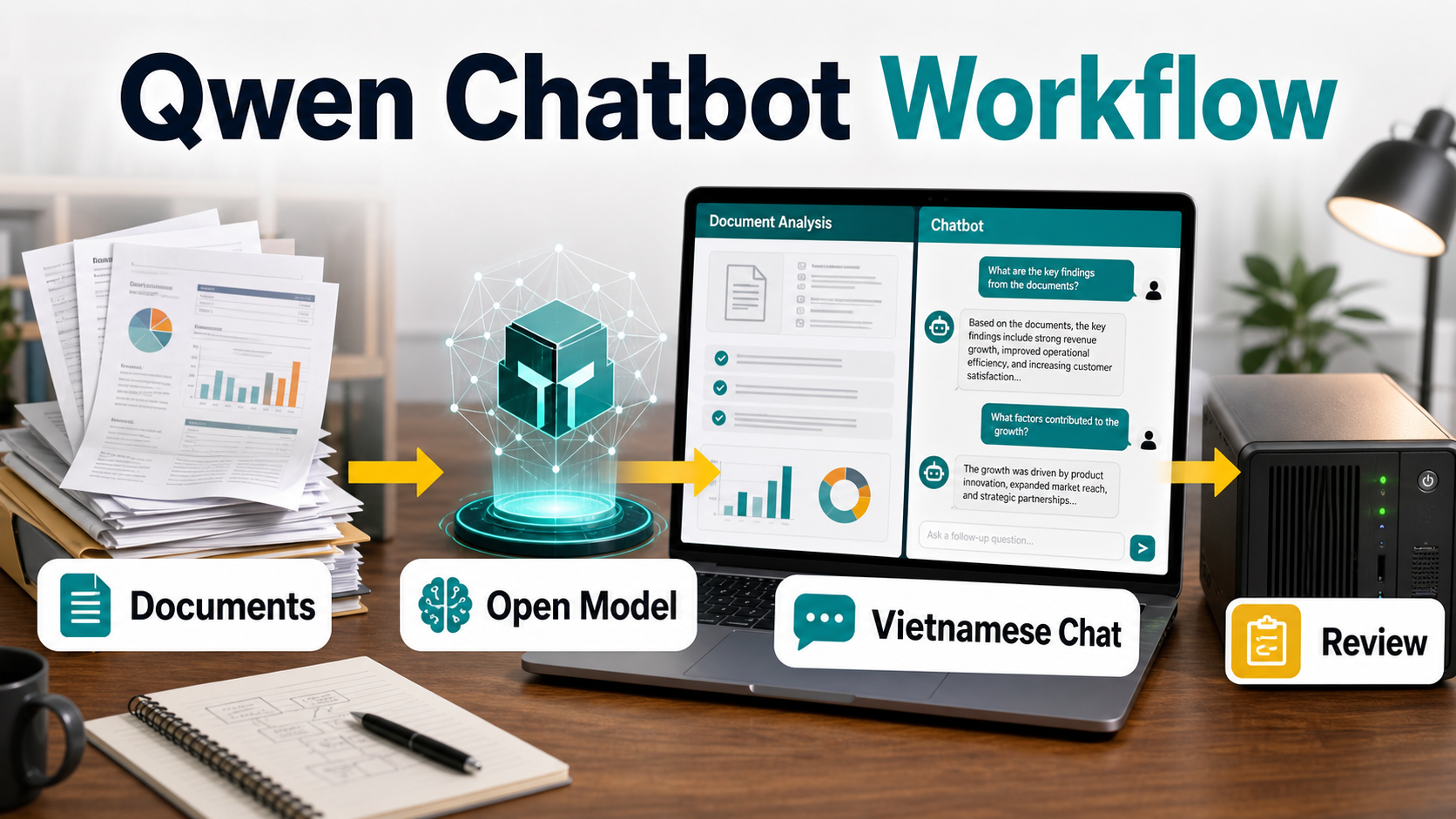
Qwen open models are a strong option for Vietnamese chatbots and document analysis when you need multilingual support, local deployment flexibility, and more control than a closed SaaS chatbot. Updated on July 2, 2026, the practical starting point is to test a smaller Qwen model for chat quality, then move to a larger or newer Qwen3/Qwen3.6 model only when your documents, reasoning, or latency targets require it.
For creators, marketers, developers, and AI tool users in Vietnam, Qwen is useful because it can support Vietnamese conversations, structured outputs, long-context document workflows, and private RAG systems. It is not a magic replacement for careful retrieval, evaluation, and human review, but it is a credible open-model foundation for business assistants, knowledge-base chatbots, and internal document tools.
What is Qwen?
Qwen is a family of large language and multimodal models from the Qwen Team at Alibaba Group. Official Qwen documentation describes the family as supporting natural language understanding, text generation, vision understanding, audio understanding, tool use, role play, and agent-style workflows.
The important word for builders is family. Qwen is not one model. It includes smaller dense models, larger dense models, mixture-of-experts models, vision-language models, and newer releases such as Qwen3, Qwen3.5, and Qwen3.6. The best choice depends on whether you need low-cost local chat, production API serving, long-context document analysis, multilingual support, or agentic tool use.
Quick recommendation
If you are building a Vietnamese chatbot, start with the smallest Qwen model that passes your real test set. For FAQs and simple support flows, a compact model may be enough. For document analysis, RAG, coding help, and multi-step reasoning, test Qwen3-8B or larger open-weight options, then compare against Qwen3.6 models if you have the hardware or serving budget.
| Use case | Suggested Qwen path | Why it fits |
|---|---|---|
| Vietnamese FAQ chatbot | Small or mid-size instruct model | Fast responses and easier hosting. |
| Private document search | Qwen plus RAG pipeline | Keeps source documents outside closed chat tools. |
| Long document analysis | Qwen3 or Qwen3.6 model with long-context support | Better for reports, contracts, policies, and transcripts. |
| Tool-using assistant | Qwen3 family with function calling or agent framework | Useful for CRM, CMS, database, and workflow actions. |
| Local experimentation | GGUF model through llama.cpp, LM Studio, or Ollama-style tools | Good for quick testing before production deployment. |
Why Qwen is relevant for Vietnamese chatbots
The official Qwen2.5 model card lists multilingual support across more than 29 languages, including Vietnamese. Qwen3 model cards also describe support for more than 100 languages and dialects. That does not guarantee perfect Vietnamese tone, legal terminology, or local business vocabulary, but it makes Qwen a serious candidate for Vietnamese-first AI workflows.
Vietnamese chatbot quality depends on more than language coverage. You need clean source documents, a strong system prompt, retrieval that returns the right passages, and evaluation examples written in Vietnamese. If the model is asked to answer from weak retrieval or outdated internal files, even a strong model will sound confident while being wrong.
Model choices: small, medium, or large?
Use a small model when speed, privacy, and cost matter more than deep reasoning. Small Qwen models can work for routing, classification, intent detection, short FAQ answers, and lightweight internal assistants. They are also easier to run on a single workstation or modest cloud GPU.
Use a medium model when the chatbot must follow instructions, answer in a consistent brand voice, summarize documents, and produce structured JSON. Qwen3-8B is a practical benchmark candidate because its official Hugging Face card lists 8.2B parameters and documents thinking and non-thinking modes, multilingual support, agentic use, and long-text processing guidance.
Use a larger model when the system must reason across many documents, extract nuanced decisions, compare policy sections, or support developer and analyst workflows. Official Qwen3 materials list open-weight dense and MoE models, including Qwen3-14B, Qwen3-32B, Qwen3-30B-A3B, and Qwen3-235B-A22B. Qwen3.6 materials also point to newer open models such as Qwen3.6-27B and Qwen3.6-35B-A3B.
Best workflow for Vietnamese document analysis
The safest workflow is RAG: retrieve relevant document chunks first, then ask Qwen to answer using only those chunks. This is better than dropping an entire document library into a prompt and hoping the model finds the right facts.
1. Prepare documents
Convert PDFs, Word files, web pages, and spreadsheets into clean text. Preserve titles, section numbers, dates, tables, and source URLs where possible. Vietnamese documents often include mixed English terms, abbreviations, and scanned pages, so OCR quality matters.
2. Chunk and embed
Split content by section, not arbitrary character count. Store chunks with metadata such as document title, date, department, owner, and page number. Use embeddings to retrieve the most relevant passages for each question.
3. Ask Qwen with strict grounding
The answer prompt should require citations to retrieved passages, direct uncertainty when sources are missing, and Vietnamese output when the user asks in Vietnamese. This reduces hallucination and makes review easier.
System: You answer as a Vietnamese business assistant. Use only the provided sources. If the answer is not in the sources, say that it is not confirmed in the provided documents.
User question: {question}
Sources: {retrieved_chunks}
Return: short answer, bullet details, source references, confidence level.
Prompt tips for Vietnamese chatbots
Write the system prompt in the same language style you expect from the assistant. If the bot serves Vietnamese customers, specify whether it should use formal Vietnamese, friendly conversational Vietnamese, or bilingual Vietnamese-English terms for technical products.
- Define the assistant role, audience, and forbidden claims.
- Tell the model when to answer in Vietnamese and when to preserve English product names.
- Require source-based answers for policy, pricing, legal, finance, or HR content.
- Ask for JSON only when your app truly needs structured output.
- Use examples of good and bad Vietnamese answers during evaluation.
Deployment options
Official Qwen materials mention several deployment paths. Hugging Face and ModelScope host model files. For serving, Qwen documentation and repositories point to frameworks such as SGLang and vLLM. For local use, Qwen materials mention tools such as llama.cpp, LM Studio, MLX, KTransformers, and related local runners.
| Deployment path | Best for | Watch out for |
|---|---|---|
| Local desktop runner | Testing prompts and privacy-sensitive prototypes | Lower throughput and model-size limits. |
| vLLM or SGLang server | Production API serving | GPU memory, batching, monitoring, and scaling. |
| Hugging Face model download | Standard open-model workflow | Check the exact model card and license. |
| ModelScope mirror | Alternative access path in some regions | Keep model versions aligned with your tests. |
| Alibaba Cloud Model Studio API | Managed Qwen access | Pricing and availability can vary by model and region. |
Pros and cons of Qwen for business AI
Pros
- Strong open-model ecosystem with many sizes and formats.
- Official multilingual support, including Vietnamese in Qwen2.5 and broad language support in Qwen3.
- Apache 2.0 licensing for the open-weight models listed in official Qwen3 and Qwen3.6 materials.
- Works with common inference stacks such as vLLM, SGLang, llama.cpp, and Hugging Face tooling.
- Useful for RAG, document analysis, structured outputs, and agent-style workflows.
Cons
- Local hosting still requires hardware, monitoring, security, and latency tuning.
- Vietnamese quality must be tested with your own documents and customer language.
- Large models can be expensive to serve even when model weights are open.
- Long-context support does not remove the need for retrieval and source checking.
- Newer model names and availability can change, so always verify official model cards before deployment.
Checklist before production
- Confirm the exact model card, license, and release notes for the Qwen model you deploy.
- Build a Vietnamese evaluation set with real customer questions and internal documents.
- Measure answer quality, citation accuracy, refusal behavior, latency, and cost per conversation.
- Use RAG for business documents instead of relying only on model memory.
- Log model version, prompt version, retrieved source IDs, and user feedback.
- Add human review for legal, medical, finance, HR, or high-value customer decisions.
Edit AI videos here
If your Qwen chatbot project becomes a training video, product explainer, sales demo, or internal tutorial, you can edit AI videos here: https://ai.alphatechnologies.vn. A simple workflow is to ask Qwen to summarize the product documentation, turn the summary into a short script, then edit the final video with captions and scene cuts.
Final recommendation
Qwen is worth testing when you want a Vietnamese-capable open model for chatbots, document analysis, and private AI assistants. Start small, benchmark with real Vietnamese prompts, and upgrade only when the test results prove that a larger model improves accuracy enough to justify the cost.
For most Aikolhub readers, the best architecture is Qwen plus retrieval, not Qwen alone. Use Qwen for reasoning, language, and structured answers, but let your document store provide the facts. Explore more AI tools and open-model workflows on Aikolhub to build a stack that matches your content, business, and privacy requirements.
FAQ
Is Qwen good for Vietnamese chatbots?
Yes, Qwen is a credible option for Vietnamese chatbots, but you should test it with your own Vietnamese questions, tone requirements, and business documents before production.
Can Qwen analyze private documents?
Yes, if you deploy it in a controlled local or private cloud environment and connect it to a RAG pipeline. The model should answer from retrieved source passages, not from memory alone.
Which Qwen model should I start with?
Start with a smaller or mid-size instruct model for FAQ and support chat. Test Qwen3-8B or larger models when you need stronger reasoning, long-document analysis, or agent workflows.
Are Qwen open models commercially usable?
Official Qwen3 and Qwen3.6 materials state that their open-weight models are licensed under Apache 2.0. Still, check the exact Hugging Face or repository license file for the model you use.
Do I still need embeddings and RAG with a long-context model?
Yes. Long context helps, but RAG gives better source control, lower prompt cost, clearer citations, and easier updates when documents change.