Fisheye and tilt-shift AI video prompts need different visual contracts. Use fisheye when you want deliberate curved space, extreme field of view, and exaggerated near-to-far scale; use tilt-shift when you need corrected architectural perspective, a rotated focus plane, or a controlled miniature-like focus effect.
This production case study builds two connected skateboard-film shots without treating either lens name as a magic token. You will block the camera, prepare references, run one-variable prompt tests, and approve only the clips whose geometry and focus survive from first frame to last.
Table of Contents

Separate the two lens jobs
The key distinction is intentional geometry. Nikon describes fisheye lenses as producing extremely wide views that bend and warp a composition. Perspective-control lenses do the opposite kind of work: shift can keep a level camera while reframing architecture, and tilt changes the orientation of the focus plane. A tilt-shift image can look miniature when most of a distant scene is blurred, but that is a creative use of tilt, not the entire definition.
Do not ask one vague prompt to produce “fisheye tilt-shift cinematic footage.” The cues can fight. A fisheye shot celebrates obvious radial curvature; an architectural shift shot often protects parallel verticals. Assign each effect a story purpose and a separate shot.
The fisheye contract
For the action shot, require four observable properties: the skateboard is close to the lens, the rider remains near the useful central area, straight lines curve more strongly toward the perimeter, and near objects appear much larger than distant objects. The effect should read through geometry even without a black circular border. A generic 14mm-looking frame with straight edges is wide, but it is not a convincing fisheye result.
The tilt-shift contract
For the transition shot, choose one tilt-shift purpose. This case uses a level elevated camera, upright buildings, and a diagonal band of sharpness that follows the skater through a city plaza. Shift supplies the perspective-correction idea; tilt supplies the focus-plane idea. Avoid claiming that a generator simulates a calibrated physical lens unless its interface explicitly exposes those optics.
Block the two-shot case study
The sequence begins with intimate action inside a skate bowl, then cuts to an observational city view. That contrast gives each specialty look narrative value: the first feels immediate and unstable; the second turns the same movement into designed choreography.

Shot A: fisheye action
- Place the virtual camera 20–40 centimeters above the bowl surface, safely outside the rider’s path.
- Let the skateboard pass close to camera while keeping the face in the central half of the frame.
- Choose one move: a short locked pass or a slow pan. Do not orbit, zoom, and roll together.
- Keep a rail or bowl lip near an edge so curvature remains visible.
- End before hands, wheels, or shoes cross the most distorted corner.
The visual outcome should be a large board and leading foot, a readable face, a sweeping curved bowl, and stable radial distortion. This differs from the 24mm wide-angle workflow, which aims to control perspective without making fisheye curvature the subject.
Shot B: tilt-shift transition
- Raise the camera above the plaza and keep the sensor plane visually level; do not aim sharply downward.
- Frame two building edges as vertical references and leave the skater’s path visible.
- Define a diagonal sharp band that intersects the rider and one architectural anchor.
- Use a locked camera or one restrained lateral slide.
- Keep foreground and far background softly defocused without blurring the entire frame.
The expected output has upright verticals, a stable focus wedge, readable subject motion, and no pulsing miniature effect. The shot is not a substitute for the shallow-depth macro method in the macro lens guide; here the focus plane and architectural perspective are the evidence.
Build the reference pack
Create one approved still for each shot. The fisheye reference should already show the near/far exaggeration and edge curvature. The tilt-shift reference should contain level architecture, two vertical audit lines, and a visible but restrained focus band. Add a clean identity crop of the rider only if the system supports it without conflicting with the hero frame.
Save a blocking note beside each image: camera height, approximate subject distance, subject position, direction of travel, protected lines, focus target, and permitted motion. Keep wardrobe, board color, light direction, and time of day consistent across both references. This lets the cut feel continuous even though the optical language changes.

Write visible prompt templates
Fisheye action template:
Low fisheye action shot inside a concrete skate bowl. The same skater passes close to the locked camera, board and leading shoe large in foreground, face readable near frame center. Bowl rim and rail curve deliberately toward the edges. Stable radial distortion, natural body motion, no zoom, no camera roll, no duplicated limbs.Tilt-shift transition template:
Elevated level-camera view of the same skater crossing a compact city plaza. Building verticals stay upright. A narrow diagonal focus plane follows the rider and central crosswalk; near roofs and distant blocks remain softly defocused. Locked framing, restrained motion, no global blur, no pulsing focus, no leaning buildings.Name visible evidence rather than stacking adjectives. “Tiny city” alone may yield toy textures; “fisheye” alone may yield a circular matte without useful geometry. Put subject, camera placement, protected invariants, one motion, and exclusions in that order.
Run a controlled model test
- Lock model version, seed, duration, resolution, frame count, guidance, and reference strength.
- Render each hero reference with no camera motion first.
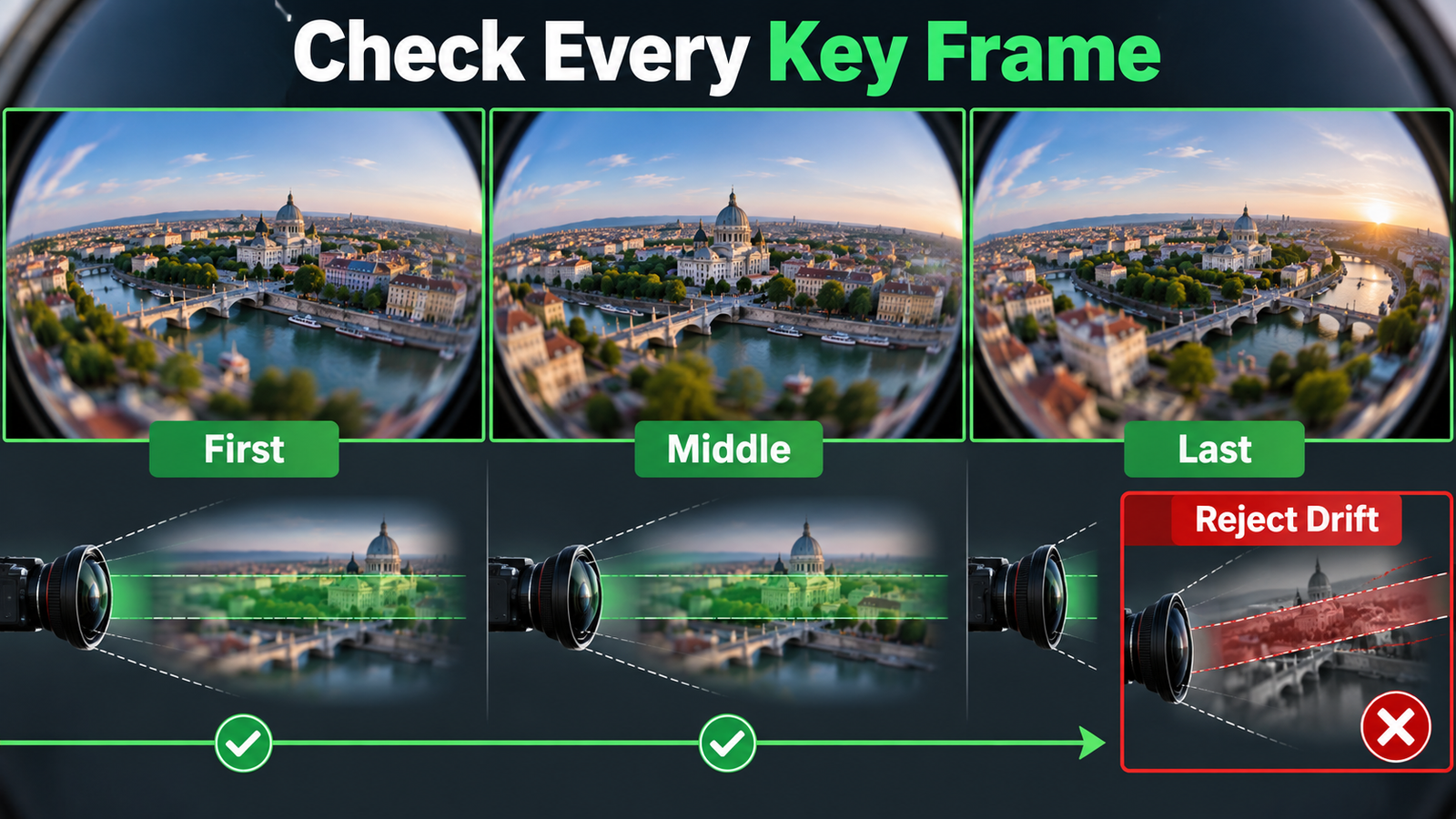
- Compare first, middle, and last frames against its shot contract.
- Add the single planned pan or slide only after the locked test passes.
- Change one failed variable per rerun: reference, distortion wording, focus wording, or motion.
- Record the prompt and result beside the approved reference.
Image-to-video is usually the practical baseline because the reference carries lens cues that text may not reproduce consistently. Camera-control research can help trajectory, but it does not automatically preserve specialty-lens behavior. CamI2V documents camera-controlled image-to-video; CameraCtrl focuses on trajectory control; UCPE documents controls for intrinsics, distortion, pitch, and roll. Review the UCPE setup guide before assuming a parameter maps to your production model.
Use the settings checklist
| Control | Fisheye baseline | Tilt-shift baseline | Reject when |
|---|---|---|---|
| Camera level | Low; horizon may curve | Level with upright verticals | Unplanned roll appears |
| Subject placement | Face near center | Rider inside focus band | Identity enters a damaged edge |
| Motion | Locked pass or slow pan | Locked or gentle slide | Geometry changes with movement |
| Focus | Rider readable | Stable diagonal plane | Whole frame blurs |
| Architecture | Curvature is intentional | Verticals remain parallel | Buildings breathe or lean |
| Duration | Short diagnostic clip | Short diagnostic clip | Late-frame drift hides in edit |
These are creative baselines, not calibrated lens metadata. Use the Aikolhub AI Video hub to find model-specific workflows, then preserve the same visual acceptance test.
Apply the continuity gate
Export first, middle, and last frames. For fisheye, score one point at each time for centered facial identity, intact board geometry, consistent edge curvature, and stable horizon behavior. For tilt-shift, score upright verticals, an unchanged focus-band angle, stable subject sharpness, and consistent background blur. Each shot has twelve available points.
Approve at ten or higher only if no critical failure occurs. A broken wheel, duplicated limb, melted face, inverted building, or full-frame focus pulse is an automatic rejection. Also compare wardrobe, board color, travel direction, and light across the cut. The expected outcome is optical contrast with story continuity, not two unrelated demonstrations.
Troubleshoot observable failures
| Symptom | Likely cause | One-variable fix |
|---|---|---|
| Fisheye looks merely wide | Camera is too far away | Rebuild the reference closer to foreground action |
| Face stretches at edge | Subject leaves central safety area | Change blocking, not distortion strength |
| Circular black border appears | Model equates fisheye with a matte | Request full-frame coverage and no vignette |
| Tilt-shift becomes global blur | Focus plane is undefined | Name its angle and two sharp anchors |
| Buildings converge | Camera appears pitched | Strengthen level-camera and upright-vertical constraints |
| Focus band drifts | Motion and focus demands compete | Lock camera and shorten the clip |
| Both shots feel identical | Only color grade changes | Restore separate geometry contracts |
Limitations and official evidence
Official sources were checked September 21, 2026. Nikon’s specialty-lens documentation distinguishes fisheye bending from perspective control, and its PC lens guide explains that shift can keep parallel lines parallel while tilt reorients the focus plane rather than simply increasing depth of field. The official CamI2V repository publishes camera-controlled image-to-video research under an MIT license and describes released research checkpoints and evaluation tools.
UCPE’s official repository describes research control over intrinsics, distortion, and orientation; CameraCtrl describes camera-trajectory conditioning. These capabilities do not prove that an arbitrary generator reproduces a real fisheye projection or Scheimpflug geometry. Prompted aperture, focal length, tilt, or shift may function only as visual language. Judge outputs, keep official parameter conventions separate, and avoid unsafe close camera placement in real action capture.
For another deliberately stylized optical workflow, the anamorphic reference guide shows how to isolate widescreen geometry and flare without confusing them with this article’s distortion and focus-plane tasks.
Edit AI videos here
Trim unstable edge frames, compare key frames, match color and motion across the cut, add licensed audio, and export delivery versions at https://ai.alphatechnologies.vn. Preserve the untouched renders, prompts, references, and scorecards beside the edit.
Final recommendation
Give each specialty lens one job. Put the fisheye camera close enough to create meaningful spatial exaggeration, keep the face protected, and use curvature as story energy. Keep the tilt-shift camera level, specify the focus plane and architectural anchors, and reject global blur. Explore Aikolhub’s practical AI video guides after both locked-camera baselines pass.
Frequently asked questions
Is fisheye just an ultra-wide lens?
No. Fisheye projection deliberately bends straight lines away from the image center. A rectilinear ultra-wide lens instead attempts to keep them straight, with different edge stretching.
Does tilt-shift always mean miniature?
No. Shift controls composition and perspective; tilt changes the focus-plane orientation. A miniature look is one creative selective-focus application.
Can one clip combine both effects?
It can, but the competing cues are difficult to diagnose. Use separate shots first, then test a deliberate hybrid only after both baselines pass.
Can camera-control models set these optics?
Some research systems expose intrinsics or distortion controls, while others control pose only. Verify the exact repository and parameter convention; do not infer calibrated optics from a lens word.
Which camera motion is safest?
Start locked. For fisheye, add a slow pan after the pass works. For tilt-shift, use a gentle lateral slide only when verticals and the focus plane stay stable.